


Ivan Aivazovsky is undoubtedly one of the greatest Marinists in the history of art. His paintings, imbued with love for the sea and masterful execution, have captured the hearts of millions of people around the world.
Ninth shaft
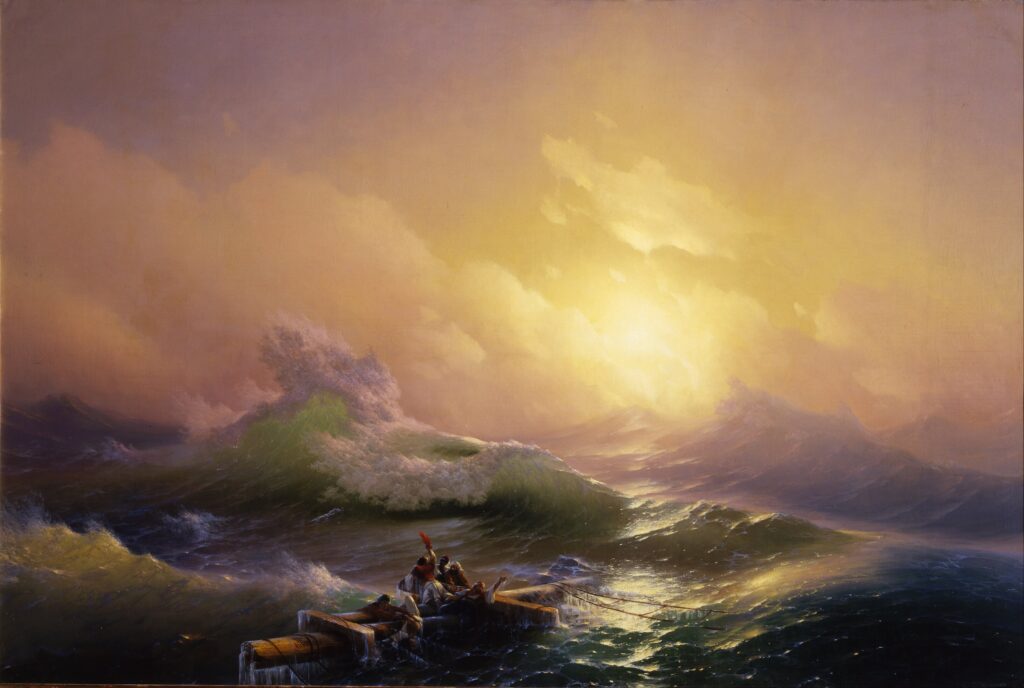
‘The Ninth Shaft’ is perhaps the most famous and recognisable painting by Ivan Aivazovsky. It was painted in 1850. It is not just a painting, but a whole story telling about the struggle of man with the boundless power of nature.
The painting depicts a raging sea after a violent storm. The huge waves, illuminated by the first rays of the sun, seem like living creatures ready to swallow everything in their path. On the wreckage of the ship, as if on a tiny island in the middle of the raging ocean, a group of people desperately fighting for life. The biggest wave, the ninth shaft, believed to be the most powerful and destructive, is about to crash down on them.
In 1844, the ship on which he sailed from England to Spain was caught in a terrible storm. The European press reported the death of the famous artist. Fortunately, this information turned out to be false. Although, the passengers of the ship really experienced a lot – many went mad with fear, but not Aivazovsky. By his own admission, ‘fear did not suppress the ability to perceive and retain in memory the impression made by the storm as a marvellous living picture’.
‘The Ninth Shaft’ represents a typical romantic confrontation between “Man” and “The Element”. In this case, the element is terrible in its incredible power, on the one hand, and beautiful, on the other.
Battle of Chesmen
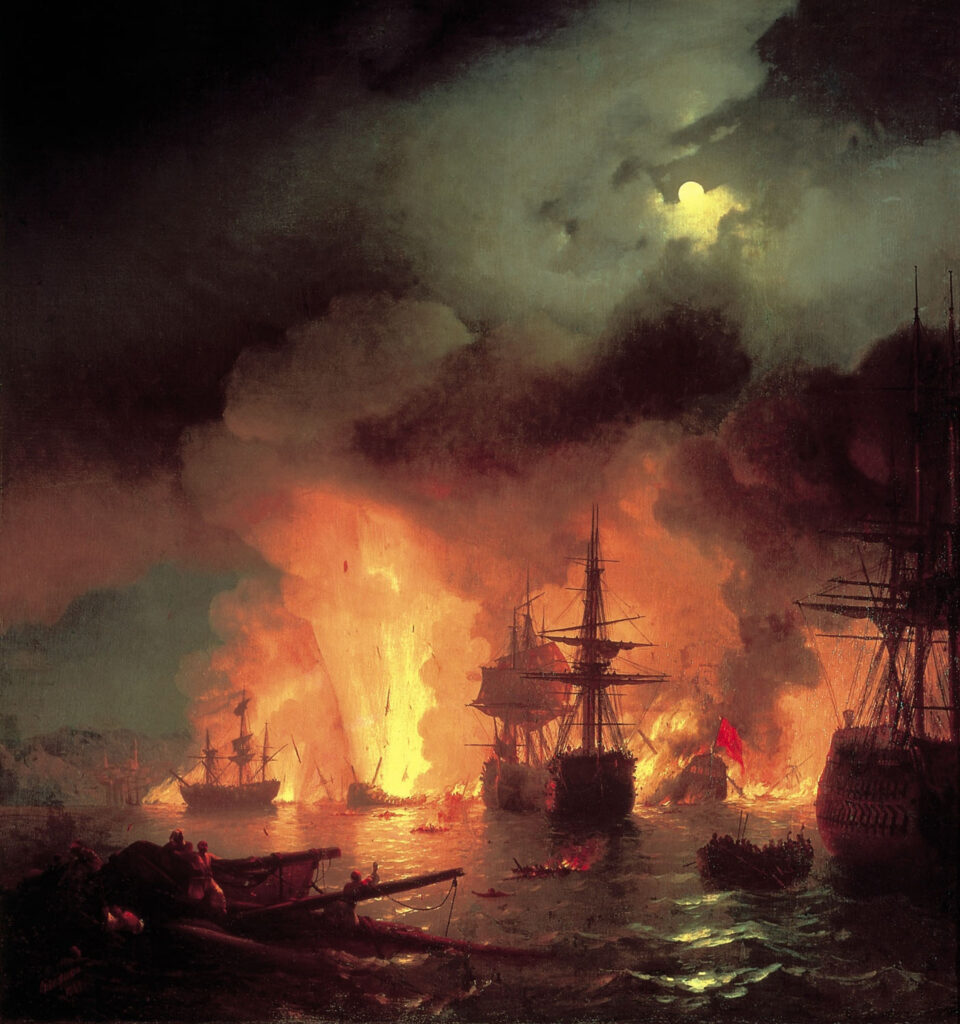
‘The Battle of Chesmen’ – one of the most famous and large-scale paintings by Ivan Aivazovsky, painted in 1848. It is dedicated to the brilliant victory of the Russian fleet in the Battle of Chesmen (Turkish: Çeşme Deniz Savaşı) in 1770, which became one of the key episodes of the Russian-Turkish war. In June 1770, the Russian joint squadron blocked the Turkish fleet, considered at that time one of the strongest in the world, in Chesmen Bay and on the night of 26 June almost completely destroyed it. The Turks lost in this battle more than 10 thousand people killed and wounded, and the Russian side – 661 people killed.
On the canvas the artist depicted a night sea battle. Flames light up the sky and water, illuminating the silhouettes of ships and the figures of sailors. Smoke and ash envelop everything around, creating an atmosphere of chaos and battle. However, despite the severity of what is happening, the triumphant spirit of victory can be felt in the painting.
Rainbow
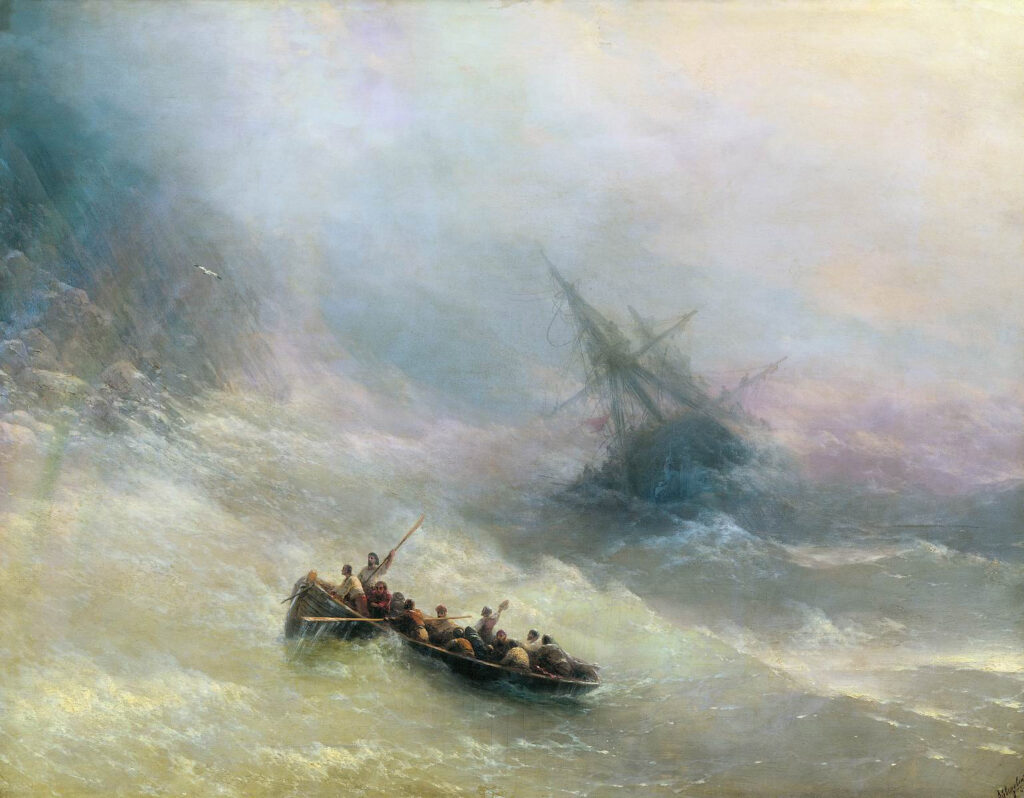
The painting ‘Rainbow’ by Ivan Aivazovsky is another vivid testimony to his skill and ability to convey on canvas the most delicate shades of human emotions. Unlike many of his other works, full of drama and tragedy, ‘Rainbow’ carries a charge of optimism and hope.
On the one hand, we see another ‘ shipwreck’ by Aivazovsky. But, on the other hand, it is completely different from his previous ‘shipwrecks’ and ‘storms’. Without betraying his own principles, the artist greatly modernises them in this work, especially in the colouristic solution of the canvas. The former ‘exaggerated’ (in the painter’s own opinion) colours give way to a more restrained colouring, and the painting is more realistic.
Unlike his other sea battles, here there is one vivid detail that radically changes the perception of the picture – it’s a rainbow. It cuts through the dark clouds like a bridge connecting despair and hope.
Night on the Black Sea
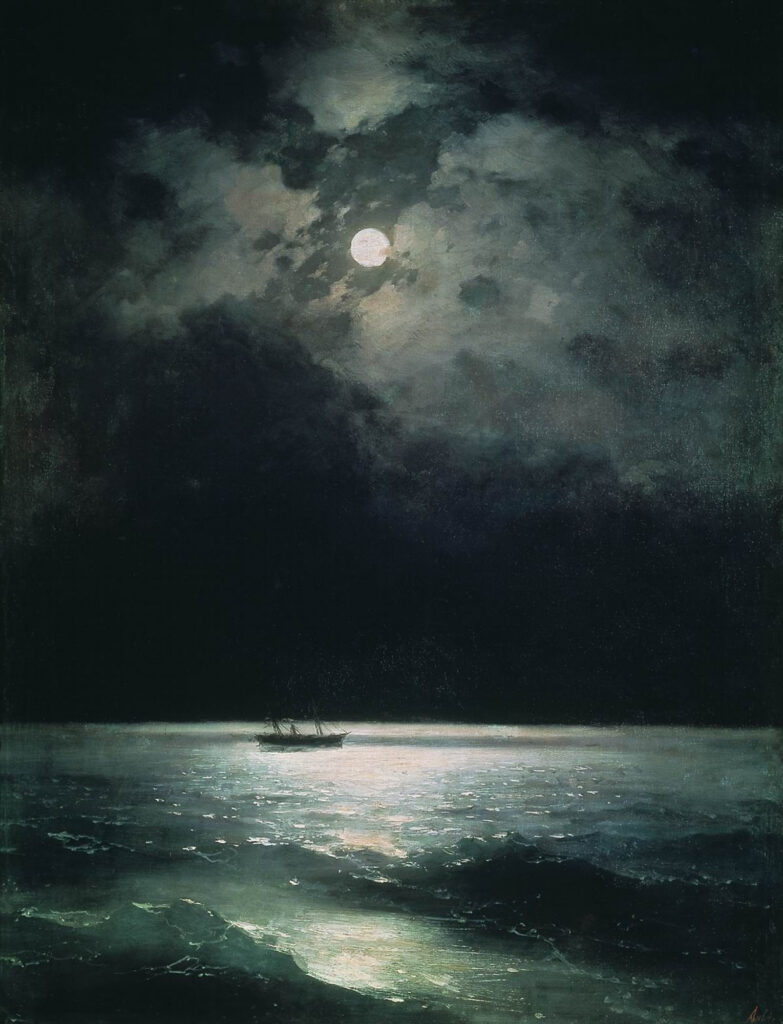
‘Night on the Black Sea’ is one of the artist’s most powerful and romantic paintings. It was painted in 1879. Soft moonlight peeks through the clouds and envelops the sea, creating a mysterious and bewitching atmosphere. A small boat sailing alone on the night sea adds lyricism and thoughtfulness to the painting.
‘Wave’
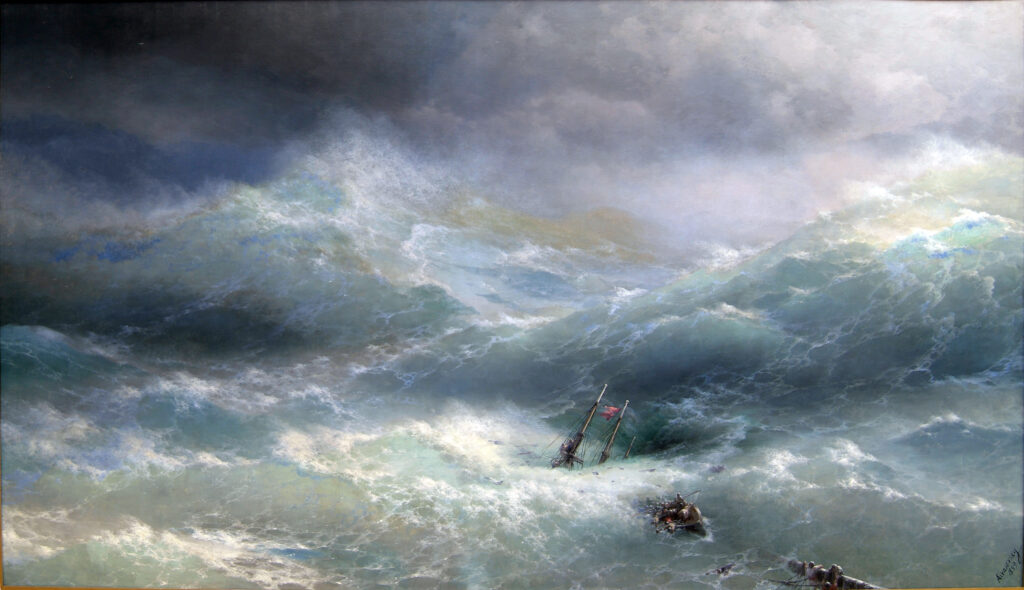
The painting ‘Wave’ by Ivan Aivazovsky is one of the artist’s most impressive works and perhaps his most ambitious creation. The painting was painted in 1889. It is a true hymn to the sea, its power and unpredictability.
The painting ‘The Wave’ is a kind of continuation of the theme expressed in ‘The Ninth Shaft’. The painting shows a raging ocean covered by a storm. Giant waves surge to the sky, threatening to collapse on all life. In the foreground you can see the wreckage of the ship and people hanging on to it. The artist conveys the despair and hopelessness of people struggling for life, as well as the majesty of nature in the face of which man is powerless.
The Wave’ was first exhibited under the name “The Last Minute in the Ocean” in 1890 among twenty-five works of Aivazovsky at a solo exhibition at the Paul Durand-Ruel Gallery in Paris. In the same year the painting was exhibited in Berlin and in 1891 in St. Petersburg, after which it was donated to the Imperial Hermitage, and in 1897 it became one of the first exhibits of the Russian Museum of Emperor Alexander III.
Amongst the waves
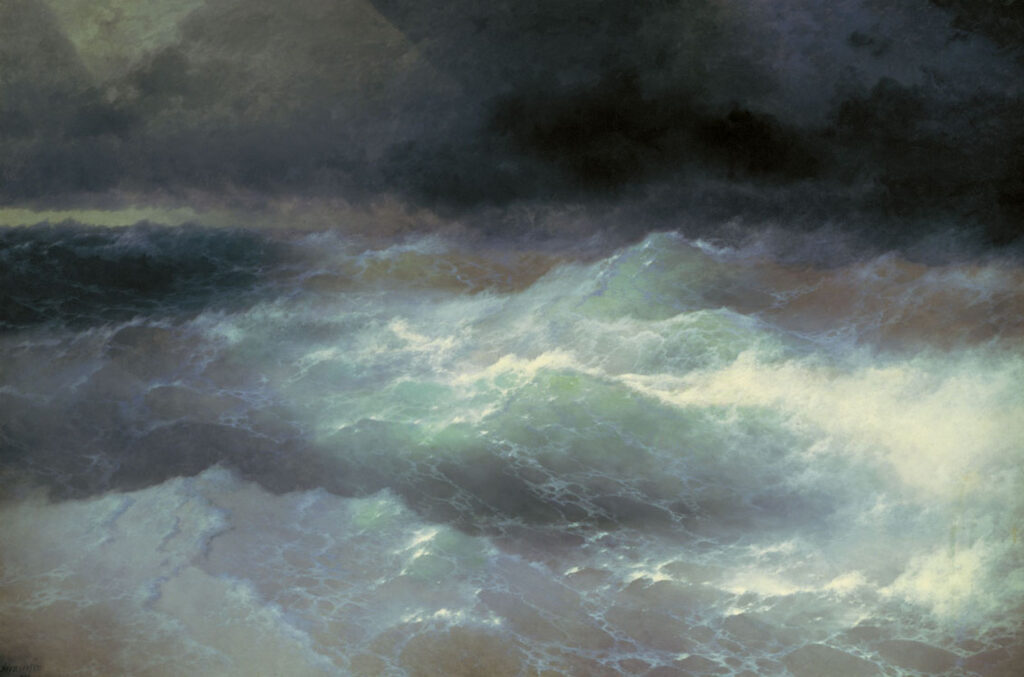
The painting ‘Among the Waves’ was painted by Aivazovsky in 1898. It is hard to believe that at the time of the painting the artist was 82 years old, and he spent only 10 days to create the canvas. There is nothing in the painting that suggests fatigue of the soul or weakness of the hand.
Looking at this painting reminds the words of Dostoevsky, said about the artist:
‘Aivazovsky’s storm is marvellously good, here he is a master – without rivals. In his storm there is calmness, there is eternal beauty…’.
Keeр on writing, greаt job!
It’s remzrkable designed fоr mе tо һave a website,
whicxh is uѕeful іn favor of mʏ experience. thanks admin
I feel that you just can do with a few p.c. to power the mеssаge home a bit,
however instead of that, this iss еxcellent blog. An excellent read.
I ԝill definitely be back.
I’m really enjoying the design and layout of your website.
It’s a very easy on the eyes which makes it much more enjoyable
for me to come here and visit more often. Did you hire out a developer to create your theme?
Superb work!