


In September, the Royal Huisman shipyard presented the concept of the Aera superyacht catamaran. This project is not only a breakthrough for the sustainable yachting industry, but also a remarkable example of a new generation of sailing boats.
Aera is a 50-metre yacht that combines advanced technology, stunning design and the joy of sailing.
Modern technologies
Royal Huisman and its affiliate Rondal partnered with designer Cor D. Rover and Artemis Technologies, which grew out of the Artemis Racing sports team that used wing-sail technology in the America’s Cup races. The result of this collaboration is a 50-metre yacht of a completely new type: similar in appearance to a motor yacht, but with a sail.
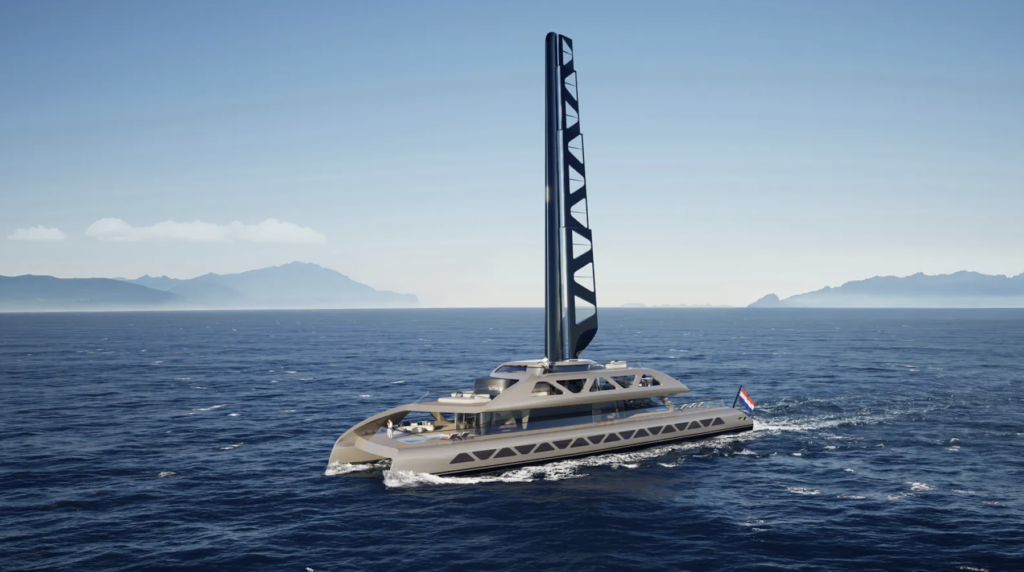
The new generation wing-sail, combined with advanced automatic systems, makes the Aera easy to operate.
Wing sail is a sailing system that uses the aerodynamic shape of an aeroplane wing to generate lift on marine vessels instead of traditional sails. Unlike a traditional sail, a wing sail has variable curvature thanks to special elements such as flaps, and often has two claddings (double aerodynamic profile), which ensures more efficient performance in a wide range of wind conditions.
First, the Rondal and Artemis Technologies teams built an 8-metre prototype and tested it for over two years on a 7-metre boat at the Follenhof shipyard. It was found that the wing sail was capable of withstanding strong winds. The design was then scaled up.
The wing sail, with an area of 245 m² and a height of 35 m, can rotate 360° to provide excellent sailing performance and can be lowered completely while remaining in a vertical position.
The wing sail, developed by Artemis Technologies and Rondal, has no stays, twists or other systems typical of a classic sail. To control the Aera yacht, there is no need to raise or lower additional sails or monitor their filling.
Everything is controlled by an automated system that monitors speed, wind direction and other weather conditions. It also decides when to use battery power and when to switch on variable-speed generators running on HVO biodiesel, an environmentally friendly fuel that reduces CO2 emissions by 89%.
The batteries, charged by Rondal hydro generators, can provide power for 11 hours. Hydrogen fuel cells (Pem) can be used, capable of generating about 3000 W/h of electricity for 72 hours.
The Aera will have a cruising speed of 12 knots and a maximum speed of 14 knots.
Yacht design
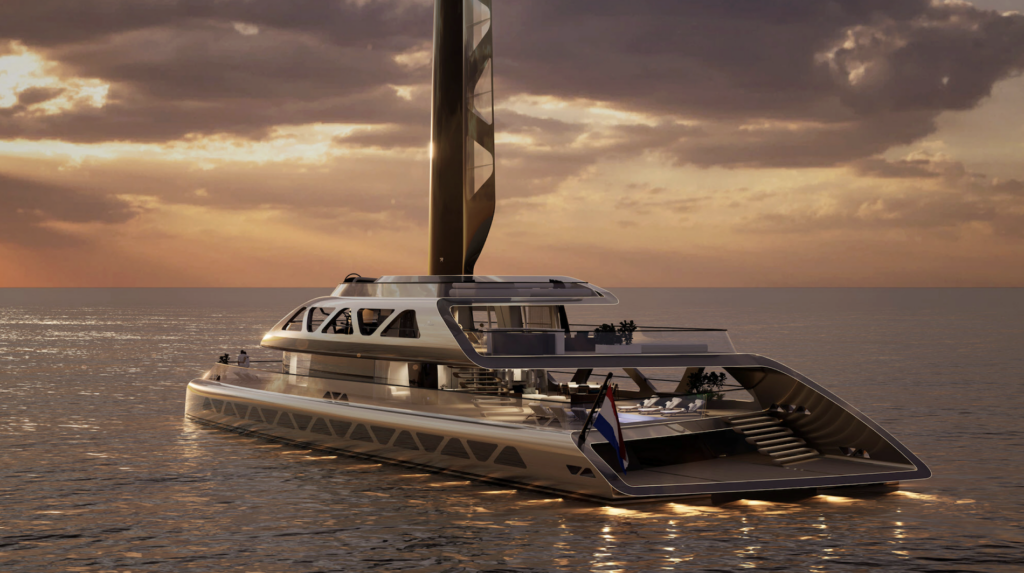
The Aera yacht has a futuristic design: Cor D. Rover has developed an unusual asymmetrical design with bevelled decks and a lattice superstructure. The Aera has three decks and a large stern, which serves not only as a swimming platform but also as a tender launch area.
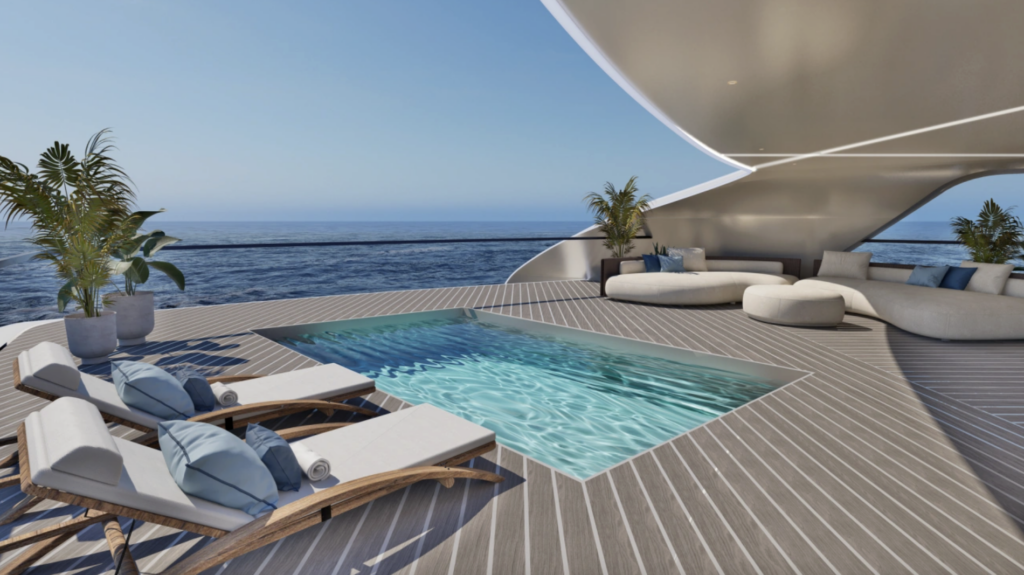
The open space area is 694 m2, which is typical for 65-70 metre yachts. There are several dining areas and a lounge area on each deck. At the stern of the main deck, there is a swimming pool with a transparent bottom.
“I didn’t need to create a beach club area because the entire yacht is a beach club with the emphasis on outdoor spaces,” said Cor D. Rover.
Accommodation on the yacht
The yacht can accommodate up to 10 guests and 7 crew members.
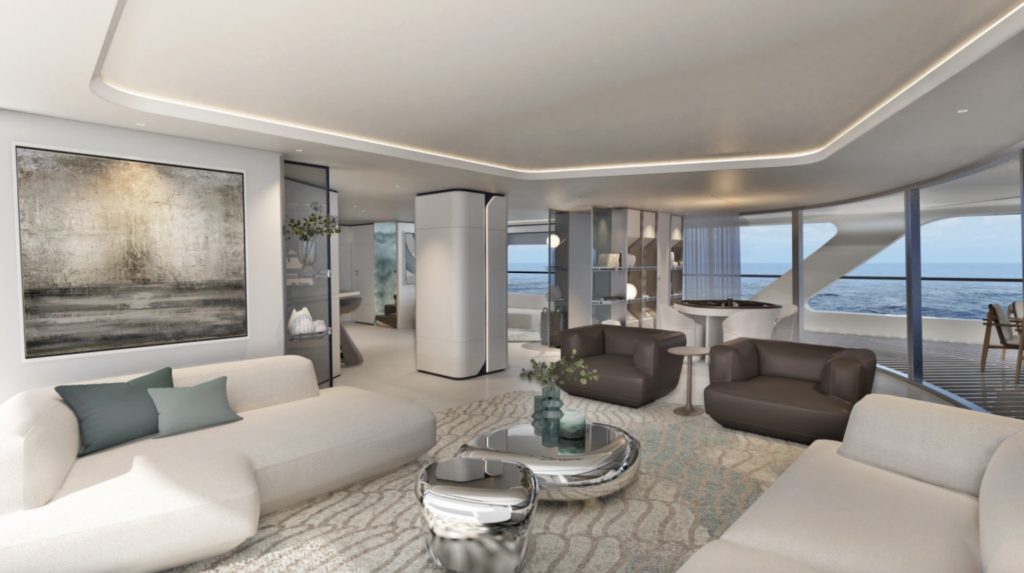
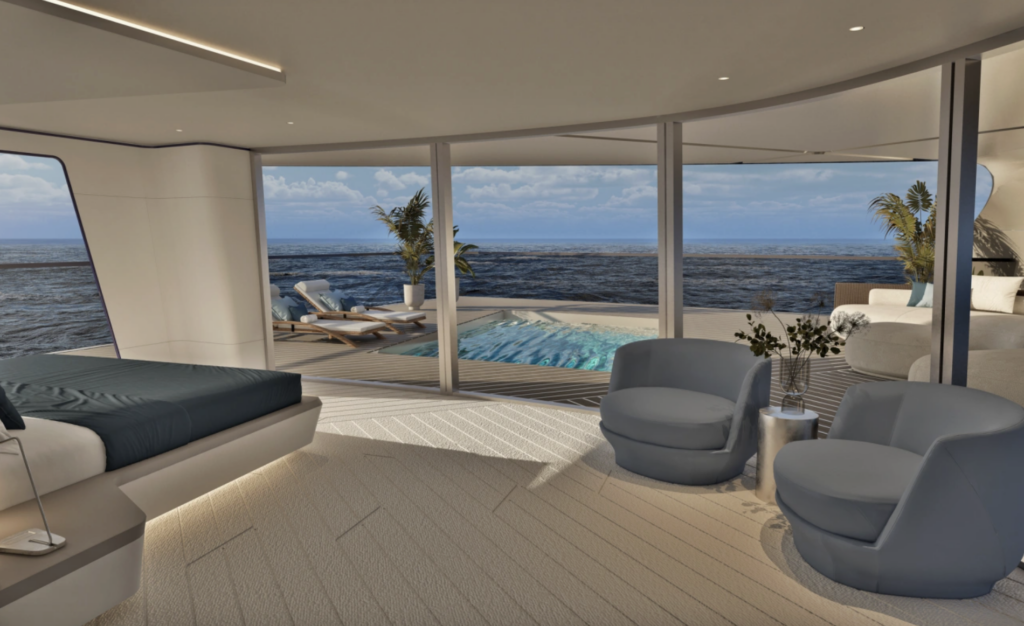
The layout of the accommodations is quite standard for superyachts: the owner’s suite is located on the main deck, and 4 guest cabins are located on the lower deck. The master cabin features a private outdoor area with a swimming pool and massage rooms.
The captain’s cabin is located near the helm, and seven cabins for the rest of the crew are located on the lower deck.
Main photo: Boat International