


At first glance, anchoring looks like a simple task. In reality, it requires planning and precise calculation.
Selecting an anchorage site
A place to anchor should never be chosen solely ‘because of the beauty of the bay’.
Choosing a bay for anchoring, especially at night, should be done, first of all, taking into account the expected wind direction. The bay should be as protected as possible. The wind should at least blow out of the bay and not towards it. A place where the wind is blowing towards the bay is extremely dangerous as the wind drives the boat onto the shore. This situation is dangerous because if the wind picks up, you may be trapped without the ability to anchor or leave the bay.
By the way, in addition to wind, it is also important to consider changes in the tidal cycle.
Seabed type
When selecting a place to anchor, captains usually use charts or special navigation programmes that inform them of the type of seabed at that particular location.
The seabed comes in several types: sand, rocks, stones, rocks, mud, coral or weeds.
In navigation applications and charts, seabed types are labelled as follows:
- S — Sand
- St. — Stones
- R— Rock
- M — Mud
- Wd — Weed
- Sh- Shells
- Co — Corals
Sometimes there are mixed types. For example, Sand&Shells or Rock&Weed.
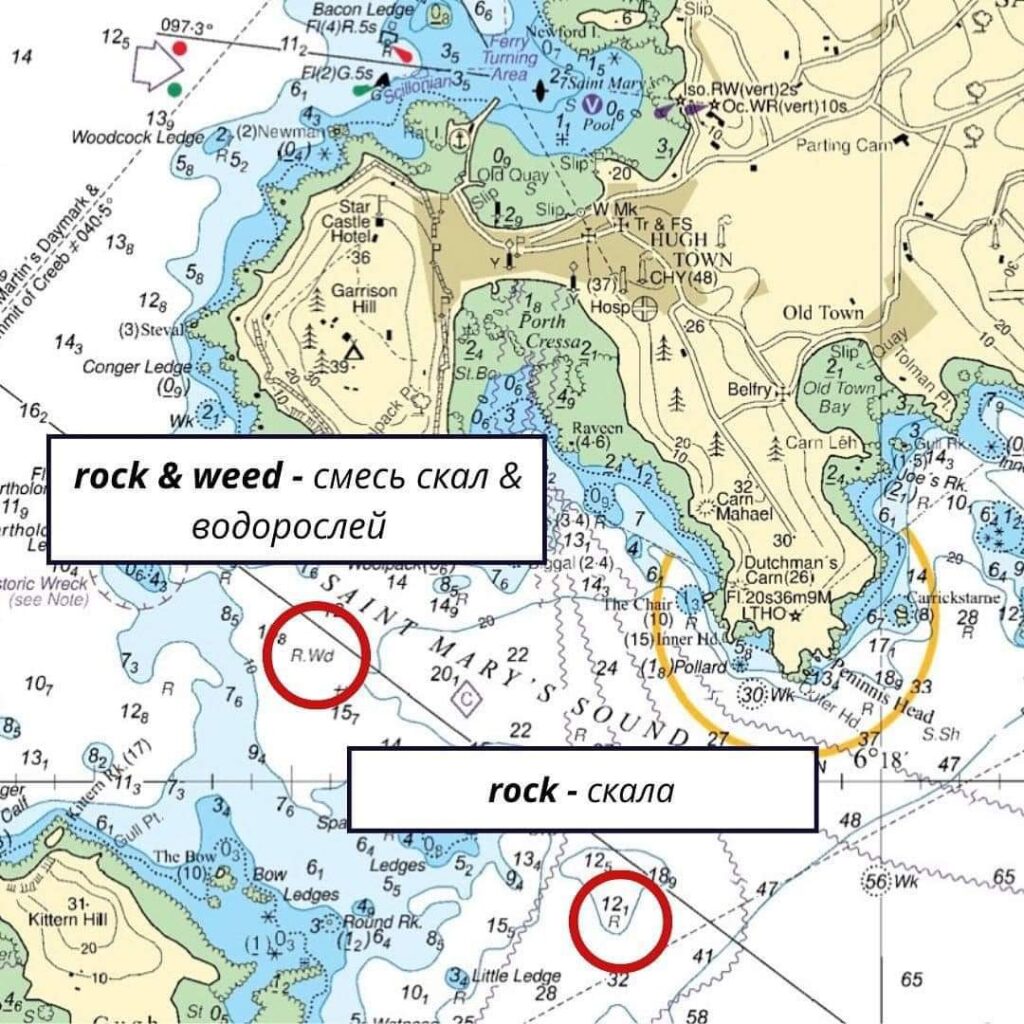
In addition, clarifications on the type of sand are also found on the maps:
- hS — Hard Sand
- fS — Fine Sand
- mS — Medium Sand
- cS — Coarse Sand
An anchor holds best on a seabed of mud and clay or clay and sand, and worst on rock or very soft mud. A seabed covered with thick sea grass or seaweed is unsafe, as the anchor may get caught in the seaweed and not hold on to the bottom properly.
Anchor, anchor chain and depth
When anchoring, it is not so much the anchor that holds the boat as the chain that lies on the bottom and whose weight holds the boat. Therefore, when dropping anchor, it is recommended to throw a chain 3-5 times the depth plus the height of the bow. On charter yachts the chain is usually 50-70 metres long, so the ideal depth for anchoring is 3-10 metres.
Important! Do not anchor at depths you cannot dive to or where visibility is poor. This is because if your anchor snags on the bottom or on the anchor of a neighbouring boat, you will need to dive in and untangle it.
It’s important to consider all scenarios
You should always consider the occurrence of unforeseen scenarios. When anchored in a bay overnight, remember that the weather may change during the night while everyone is asleep. A change in the weather, especially the wind, can cause the boat to drift out of place. In this case, make sure that there are no other boats within a radius of your anchorage.
Main photo: David Lezcano on Unsplash