


Yachting holidays are fun, but you should always be prepared for sudden changes in the weather. It doesn’t matter if you are a yachtsman or just decided to take a vacation on a yacht. One of the most important tools for understanding and evaluating wind conditions is the Beaufort scale. The Beaufort scale is a universal system for measuring wind speed based on its observed effects on sea and land.
Origin and development
The Beaufort scale was developed by Admiral Sir Francis Beaufort of the Royal Navy in 1805. Originally developed for naval purposes, it quickly became widespread among sailors and meteorologists. The scale ranges from 0 to 12, with each level corresponding to a particular wind speed and its associated environmental impact.
Importance to yachtsmen
For yachtsmen, understanding the Beaufort scale is important for making informed decisions about sailing conditions and safety. By determining wind levels and their potential impact, sailors can adjust their sailing plans or even begin to seek shelter if necessary.
However, it’s not just sailors who need to be aware of the Beaufort scale.
Hikers, campers and outdoor enthusiasts: The Beaufort Scale can be a valuable tool for assessing wind conditions if you are planning a hiking or camping trip.
Pilots: The Beaufort Scale is also used by pilots to assess wind conditions. For example, pilots need to know wind speed and direction to calculate a safe landing speed and avoid turbulence.
People living near the coast: The Beaufort Scale can also be useful for people living near the coast, as it can provide advance warning of a potential storm or high winds.
Understanding the Beaufort scale
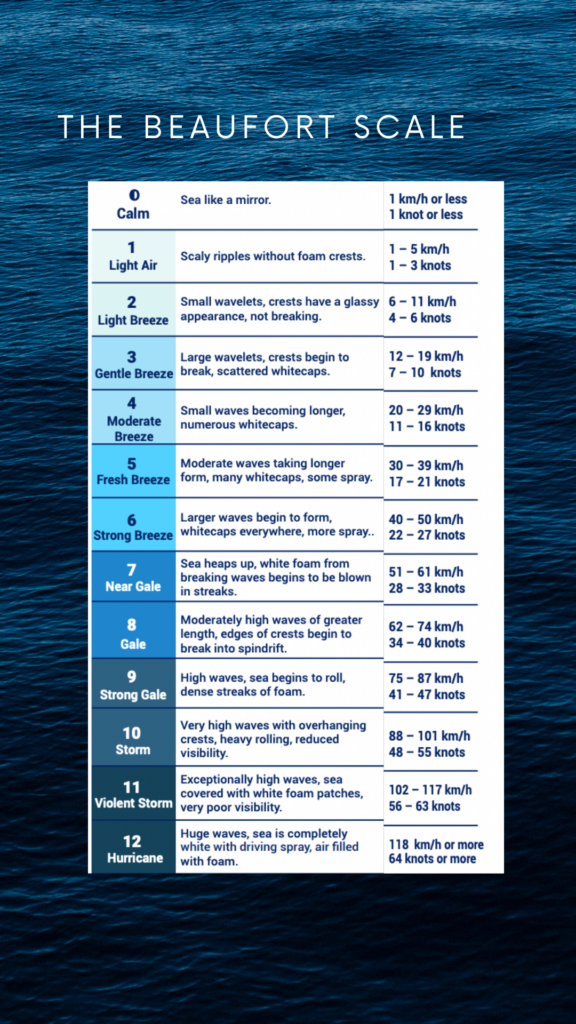
0: Calm: The sea looks like a mirror and the smoke rises vertically.
1: Light Air: Ripples with the appearance of scales are formed, but without foam crests. The drift of the smoke indicates the direction of the wind, and yet there may be some movement on the wind blades.
2: Light breeze: Small wavelets, still short, but more pronounced. Crests have a glassy appearance and do not break. The sea is still calm. Light flags are flying. Wind felt on face; ordinary vanes moved by wind.
3: Gentle Breeze: Large wavelets. Crests begin to break. Foam of glassy appearance. Perhaps scattered white horses. Leaves and small twigs in constant motion; wind extends light flag.
4: Moderate breeze: Small waves, becoming larger; fairly frequent white horses. Larger waves form more slowly. Raises dust and loose paper; small branches are moved.
5: Fresh Breeze: Moderately high waves with white crests of foam. Moderate waves, taking a more pronounced long form; many white horses are formed. Small trees in leaf begin to sway; crested wavelets form on inland waters.
6: Strong breeze: Large waves begin to form; the white foam crests are more extensive everywhere. The foam spreads in streaks in the direction of the wind. Large branches in motion; whistling heard in telegraph wires; umbrellas used with difficulty.
7: Near Gale: Sea heaps up and white foam from breaking waves begins to be blown in streaks along the direction of the wind. Whole trees in motion; inconvenience felt when walking against the wind. The wave crashes into foam against the shore.
8: Gale: Moderately high waves of greater length; edges of crests begin to break into spindrift. The foam is blown in well-marked streaks along the direction of the wind. Breaks twigs off trees; generally impedes progress. Smaller vessels begin to rock at anchor.
9: Severe Gale:High waves. Dense streaks of foam along the direction of the wind. Slight structural damage occurs (chimney-pots and slates removed) Crests of waves begin to topple, tumble and roll over. Spray may affect visibility Big ships are hard to sail.
10: Storm: Very high waves with long overhanging crests. The resulting foam, in great patches, is blown in dense white streaks along the direction of the wind. On the whole the surface of the sea takes on a white appearance. Seldom experienced inland; trees uprooted; considerable structural damage occurs. The tumbling of the sea becomes heavy and shock-like. Visibility affected. Big ships in distress.
11: Violent Storm: The sea is completely covered with long white patches of foam lying along the direction of the wind. Everywhere the edges of the wave crests are blown into froth. Visibility affected. Whole trees flying apart. Wide-spread damage. Exceptionally high waves (small and medium-size ships might be for a time lost to view behind the waves).
12: Hurricane (typhoon): Sea completely white with driving spray; visibility very seriously affected. The air is filled with foam and spray. Entire trees have been ripped out by the roots. Sailing is impossible.