


This method of mooring is most commonly found in urban moorings in Greece or in the Mediterranean, hence its name. However, it can be used wherever it is necessary to anchor to land and there is no other way to secure the boat.
Pros and Cons
A mooring with the ropes stretched to shore is one of the options for anchoring a yacht. In this type of mooring, the yacht is secured at three points: at the bow by the anchor and at the stern to the shore by two long lines.
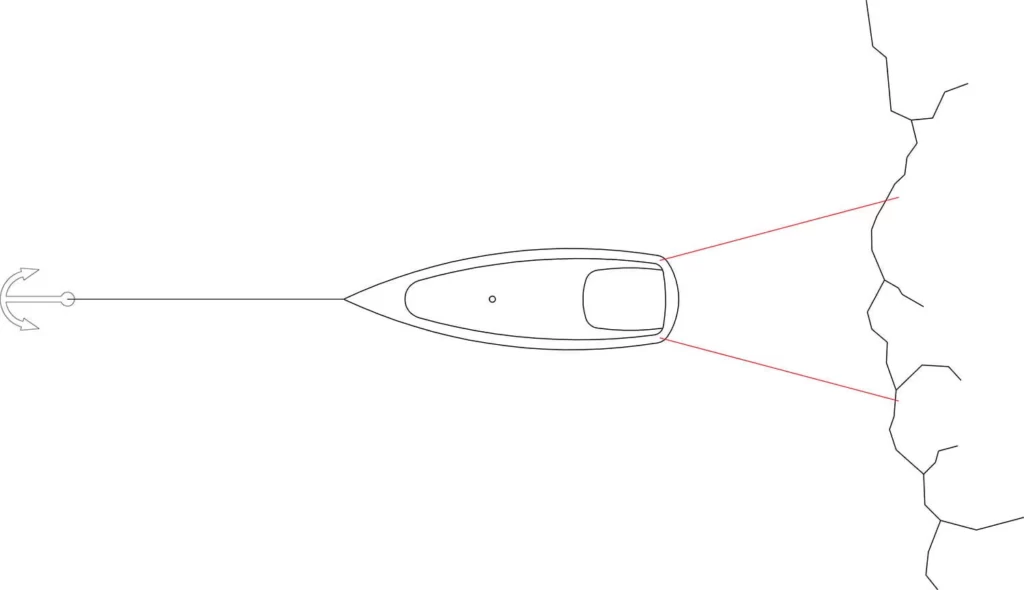
The main advantage of this mooring is that, unlike a normal anchorage, the yacht will not spin around the anchor in case of wind changes.
But this advantage can easily turn into a disadvantage: in a side wind, the yacht will not turn upwind, as it usually does at anchor, and will be very choppy on the waves. It can be very uncomfortable to be on the boat.
It is therefore necessary to keep an eye on the weather forecast at regular intervals when mooring in the Mediterranean. Also, before anchoring in this way, it is advisable to study the pilotage, which will tell you the optimum mooring method for a particular location.
Mediterranean mooring: step by step
There are several possible ways of Mediterranean mooring.
Method 1
This method is suitable for a crowded bay where there is little space:
- Walk along the bay and choose a parking spot.
- Prepare a long mooring and send the sailor with it to the shore on a dinghy
- Fasten the mooring (it is best to make a loop with a bowline and fasten it to a tree, large rock or cliff).
- Take the free end of the rope and swim towards the yacht.
- While one of the sailors is engaged in mooring, approach the planned place, give anchor
- When the anchor has sunk to the seabed, start moving backwards (towards the shore)
- In parallel, we give the required length of anchor chain so that it lies evenly on the bottom
- Watch the depths so you don’t hit a rock or puddle
- If correctly calculated, approaching the planned anchorage, the yacht will meet the dinghy
- Take the mooring from the sailor on the dinghy and secure to windward side
- Fasten one end of the second (leeward) mooring and send the sailor on the dinghy back to shore to secure it
- Selecting slackness when pulling the mooring lines
Important! For a more confident anchoring of the boat, it is better to secure the moorings at right angles.
Method 2
This method is suitable for situations where there is no strong wind and there are not many yachts in the area
- Selecting a parking place
- Approach the chosen spot and drop anchor
- When the anchor has sunk to the seabed, start moving backwards (towards the shore)
- In parallel, we give the required length of anchor chain so that it lies evenly on the bottom
- Approaching at an optimum distance from the shore, prepare a long mooring line
- Leave one end of the mooring line on the boat and tie it off to windward
- If necessary, loosen the mooring a little when moving dinghy
- The sailor ties the mooring on shore to a rock, rock ledge or tree
- While the sailor on the dinghy is returning, secure one end of the second mooring to the boat (leeward side)
- Wait for the sailor to return to the dinghy and send him off to secure the second mooring
- When the moorings are secured, pick slack and pull up a little towards shore
- At the same time we check the anchor strength: see if the position of the yacht changes in relation to other yachts.
Leaving the bay
When leaving, proceed in the reverse order:
- Untie the leeward mooring from the shore and pick it from the yacht
- Then untie the windward mooring and select it
- Start moving towards the anchor location
- In the same time as the movement, raise the anchor
- Making sure the anchor is up and clean of dirt
- Let’s go 🙂
Main photo: Kipras Zabeliauskas on Unsplash